There's a particular way women read things like this.
Late. Volume low. Phone tilted away from the door. Not because anything is being hidden, exactly — but because saying I'm looking into this out loud would turn into a conversation you don't have the energy for tonight.
If that's how you're reading right now, you should know it's the most common way this gets read.
Let's take one thing off the table first
You are not here because you want to leave.
Most women who look into this are not looking for an exit. They're looking for a way back. They want the marriage — they just want it to stop costing this much.
Nothing on this page will tell you to go. Nothing here will tell you your marriage is over, or that he's a bad man, or that you've wasted your years. That isn't what this is.
What follows is about one thing only: being able to see clearly. What you do afterward is yours.
The confusion is not a side effect. It's the main event.
Here is the thing almost nobody names.
When a relationship becomes unhealthy in a quiet way — no violence, no affair, nothing you could point to — the first symptom is not sadness. It isn't anger either.
It's confusion.
You lose the ability to tell whether what just happened was a small thing or a real thing. You replay a conversation four times and land somewhere different each time. You start needing someone else to tell you whether you're allowed to be upset.
That erosion of self-trust is the pattern. Not a reaction to it.
Which is why "am I overreacting?" has been sitting in your head for months. You're not fragile. You've slowly been separated from your own read on reality, and nobody handed you the words for it.
And then there's the part where you become the problem
You absorb it. You absorb it again. You stay calm for a long time.
And then one day you don't. You snap, or you say something sharp, or you cry in a way that feels out of proportion.
And that becomes the thing that gets discussed.
Not the months of absorbing. The ten seconds of reacting. Suddenly you're the one who needs to apologise, and there's a kind of logic to it, because you did react badly, and now you can't tell whether you were pushed or whether you're just difficult.
If you've lived that loop, you already know it doesn't have a name in ordinary conversation. It has one. Naming it changes what you're able to see.
The question underneath everything
Here's what makes this so much harder for a woman who takes her faith seriously.
You've likely been taught, directly or by implication, that enduring is the spiritual assignment. That a good wife is selfless. That love bears all things. That wanting less pain might be wanting too much.
So the question sitting under all of it isn't really is this healthy?
It's: am I even allowed to ask?
Let's answer that plainly.
Scripture tells you to guard your heart, because everything you do flows from it (Proverbs 4:23). Jesus withdrew from crowds that demanded more of Him than He would give. Paul named conflict openly rather than absorbing it silently.
Boundaries appear all through Scripture. They're not the opposite of love — they're the structure that keeps love from becoming something else.
And there's a question worth sitting with, one that women in long marriages ask eventually:
Is it perseverance — or is it slowly disappearing?
Those aren't the same thing. One is faithfulness. The other is just endurance with a spiritual word attached to it. Being able to tell them apart is not disloyalty. It's the beginning of honesty.
Why he genuinely doesn't see it
Something else is happening, and it isn't imaginary.
Researchers at the University of Bath surveyed more than 2,000 partnered parents in 2025 about the invisible work of running a family — the remembering, planning, anticipating. Mothers carried about 67% more of it than fathers.
The important finding wasn't the gap. It was that the fathers didn't know. Asked to describe the split, they consistently described it as roughly even.
A Stanford study found the same shape elsewhere: in marriages, women reported lower relationship quality than their own husbands did — while in unmarried couples, both partners reported about the same.
Same relationship. Two different experiences of it. And he isn't lying to you when he says things are fine. From where he stands, they are.
So when he says he thinks the marriage is above average and you feel completely drained, you are both telling the truth. That gap is the loneliest thing about it — and it's real, measurable, and not a sign that something is wrong with you.
What you actually need is smaller than you think
Not a decision. Not an ultimatum. Not a plan.
Words.
The reason you can't explain this to your sister, or your small group, or him, is that you have a feeling and no vocabulary. A feeling without vocabulary always sounds like an overreaction — including to yourself.
Once you can name a pattern, things change fast. You stop rehearsing conversations in the shower. You stop needing someone else to confirm you're allowed to be upset. And you can finally say something true out loud instead of circling it.
Naming it is not leaving. It's the opposite. It's what makes staying honest instead of quiet.
That gap — between what you sense and what you can say — is why we made Finally See Clearly.
Four guides. One job: give you language.
Not a verdict on your marriage. Not instructions. Words for what you've been carrying, so you can look at it directly instead of wondering whether you're imagining it.
What's inside
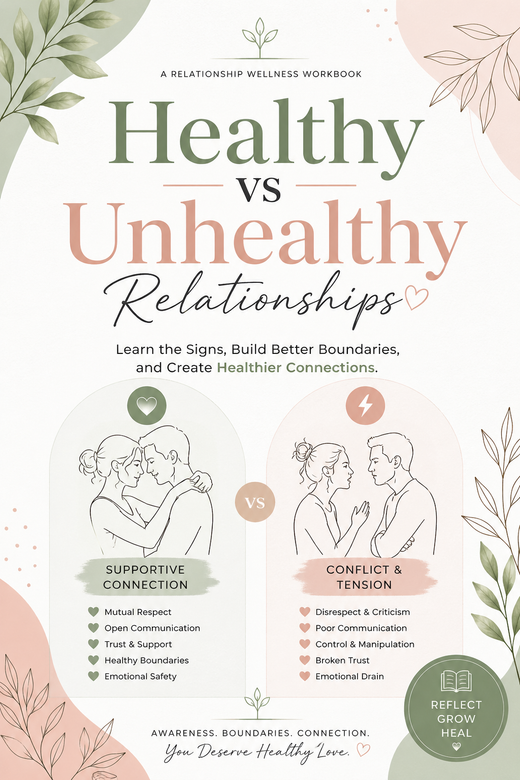
- Healthy vs. Unhealthy Relationships — A Christian Woman's GuideThe 38-page workbook. The quiet patterns, the subtle signs, and what mutual respect actually looks like.
- Healthy vs. Unhealthy Relationships — the ebookThe same ground in reading form, for nights when a workbook is too much.
- How to Identify an Unhealthy RelationshipThe patterns named plainly. This is the vocabulary section.
- The Calm Feminine WomanFor after the naming — staying steady in yourself while you work out what you think.
Yours instantly. On your phone, or printed if you'd rather.
All 4 guides. One payment. Instant access. Yours to keep.
Wondering if this means leaving him?
It doesn't.
This is private, judgment-free, and makes no argument about what you should do. Many women use it to build something stronger with the same man — because you can't repair what you can't name. Whatever comes next is yours to decide, and this is here for that decision either way.
🔒 How this arrives
The email says "Your download is ready." It doesn't name the product. Your card statement shows Bookmarks & Beaux — nothing more. The files live on your phone, where nobody else is looking.
You don't have to explain this to anyone.
Before you ask
What if he sees it on my phone?
The delivery email doesn't name the product and the billing descriptor doesn't either. Nothing about how it arrives announces what it is.
Will this tell me to leave?
No. It gives you language, not instructions. Whatever you decide, you'll be deciding with clear eyes instead of a fog.
Am I sinning by even questioning my marriage?
Scripture asks you to guard your heart. Understanding what you're carrying isn't disloyalty — it's the only honest place to start.
What if I really am too sensitive?
Then this will show you that, gently and privately, and you'll be able to stop wondering. Either answer is better than the not-knowing.
Will this help if he never changes?
It isn't about changing him. It's about you being able to see clearly and stop doubting yourself — which is worth having regardless of what he does.
Is this real biblical guidance or therapy with verses added?
Scripture is throughout, and it's used where it genuinely speaks to the subject — boundaries, worth, honesty, peace. It isn't decoration.
What if it isn't for me?
Thirty days, full refund, no questions.
If you're not safe
This is a workbook, not counseling, and it isn't crisis support.
If you're afraid of him — physically afraid — please talk to someone tonight. Free, confidential, 24 hours:
National Domestic Violence Hotline · 1-800-799-7233 · text START to 88788
You don't have to be certain anything is wrong to call. That's what they're there for.